Showing posts with label Environment. Show all posts

Thursday, December 06, 2007

Connect with nature everyday

Lately I've had my window open. The weather is absolutely gorgeous! Everyday, I pull the curtains aside and watch the birds on the trees right outside my window. I can hear them chirping throughout the day, a very welcoming distraction when I'm working.

It's really important to have a direct connection with nature every day of your life. The signs of Allah (swt) are manifest in his creations in a much better way than they are in the creations by humans.
And every time I venture out into the desert, I try to imagine the serenity and peace our Prophet (pbuh) and his companions experienced when they would spend time alone. I appreciate the desert more each day.

It’s easy to go several months without ever touching the earth, as most of our activities involve walking on pavement as we move from home to car to office to grocery store and back again. When was the last time you sat down on the ground or touched the earth in some way?

I feel quite sad when I see people overloading themselves with painkillers for a headache or any type of pain. Our lifestyles are harming us, and we don't even realise because time just flies. We have stopped breathing. And something as simple as breathing can solve a lot of problems.

Physical contact with soil, natural waters, sunlight, and fresh air is healing. When stress has built up to the danger point, a trip to the ocean or mountains, or even a walk around the block, is often all you need to restore perspective. Beyond that, contact with nature keeps you apprised of your place in the ecological system. Many of nature’s forces are stronger than an individual human, just as many species are more vulnerable than humankind. This humbling perspective keeps the big picture in mind.

You need to remember that your true environment is far more than just the stimulation and context of your relationships, ambitions, career, family, home and so on.

Start Today
Here are some simple ways to connect with nature again:

  • Go barefoot. Feel the grass or the gravel or the hard-packed earth under your feet. Wade in a rain puddle, or walk barefoot in the snow for a new sensation!
  • Grow plants or flowers and let your fingers touch the earth.
  • Keep living green plants and flowers around your house.
  • Get outdoors, if only for a few moments a day. Let the sunlight touch you and warm you. In the heart of a city, it is still possible to find green zones.
  • Listen to the sounds of nature—the wind blowing, rain falling, birds chirping—even in the midst of an urban environment.
  • Prepare your meals using fresh and raw foods whenever possible, or bake your own bread. Carefully handling the fruits of the field reminds you of your connection to the earth.
  • Practice the Native American way of adapting yourself to nature, rather than trying to make nature adapt to you. For example, avoid dependency on air-conditioning in hot weather. In cold weather, keep the heat in your home at 68°F (20°C) or lower.
  • When you are around young children, use language that communicates a healthy respect for the power of nature and a sense of awe at its beauty and mystery. Avoid teaching them that soil is dirty or that any creatures (even so-called vermin) are bad.
  • Exercise outdoors as much as possible. Take a hike. Go for a bike ride instead of driving your car to the corner store. Rollerblade in the park, or get a group of friends together for a ball game or a kite-flying party.
  • Plan your vacations for maximum enjoyment of the outdoors (with minimal environmental impact). Even a one-day family trip with a picnic can be a tremendously healthy break in your normal routine.

Tuesday, November 06, 2007

2 hours in Antarctica

Rosemarie and Pat Keough’s two hour presentation, Passion and Obsession, on their life and photography in Antarctica on October 31st was one of the most inspirational, beautiful and enriching experience I’ve had in a long time. It was truly a privilege to be in their presence and learn so much about the highest continent through their eyes. Some facts that would interest you:

  • The interior of the continent is technically the largest desert in the world and the snow feels like sand.
  • 24 hours sunlight throughout the day can easily cause insomnia.
  • 99.6% of the continent is ice with 70% of world’s freshwater.
  • 200 people get to go every year.
  • Antarctica is home to more than 70 lakes that lie thousands of meters under the surface of the continental ice sheet. They are at 22 degrees Celsius with honey comb structures of ice.
  • Antarctica does not have a cloud cover (due to global warming) unlike the Arctic.
  • Antarctica is home to many volcanoes, only Mount Erebus is known to be active.
I was in awe as they described the making of their award-winning book ANTARTICA with state-of-the-art combination of “hollow-back split board” and the “classic European full-leather” styles of fine morocco binding. The book weights 19.2 pounds, a marvellous effort of four artisans, assisted by two sewers over the span of 10 years for a total of 950 copies that will be preserved forever.
It’s almost unfair to talk about their work without the actual photographs. Rosemarie talked about how she spent five hours in the snow with her chin sticking out for almost a month just to focus on and photograph a section of the largest penguin colony. Pat explained his amazing relationship with his wife and how it helped saves their lives in the worst of storms and many other narrow near-death experiences such as hanging off cliffs! Everyone in the audience noticed how both of them would complete the other's sentences very seamlessly. When they first met, it was on a one-month cruise so they had no choice but to get along, and more than 2 decades later their love has only grown.
I explored twenty four months of their lives, as they switched between the pictures of the polar plateau of the interior, the majestic mountainous coast, multitudes of off-lying islands, icy seas, stormy Southern ocean, and delightful colonies of different penguins species, fur seals, mosses, lichen, and many types of algae.
White, with hints of subtle colours, had never been so beautiful before. At one point during the presentation, I was quite moved, longing to take the daring trip myself. You do not have to be a photographer to appreciate the depths of the Keough’s unparalleled photography that included a variety of perspective, geometrical contrasts, panoramic views and close-ups all taken with their plain 30-year old Nikon camera!
The presentation ended with Pat and Rosemarie talking about their cause- Donating all the profits from the books sales to the Save the Albatross Foundation, and other international wildlife charities. There’s much work to be done, if we want to save our environment.
You can visit their website at: http://www.keough-art.com/ and read more about their work.

Time Magazine: http://www.time.com/time/2003/antarctica/
Los Angeles Times:
http://www.latimes.com/news/science/environment/la-os-antarctica20jan20,0,459112.story?coll=la-news-environment


I wanted to know how this affected them spiritually. They responded that both of them were not religious, but there's definitely that sense of smallness, and the supremacy of nature when they are out there. Pat said that it's extremely energising (and he did a light bounce) and wondered why people get into drugs- all they need is a trip down there! Subhanallah. In winters the ice doubles to twice the original distance. It's easy to tell the different species of penguins apart, especially the Macaroni (hair-styled) penguins. The abandoned shacks preserve the smell of sweat and tobacco until today. Aren't these miraculous signs of Allah (swt)?
I thought about the challenges a Muslim would face if he/she would venture into the cold- How to pray, and how many times a day? In which direction? Our religion has answers to all these questions, Alhamdulillah.

Monday, October 15, 2007

Today is Blog Action Day!

Imam Zaid Shakir's event on SunniPath less than 12 hours ago, was one of the best lectures I've heard by him. Inshallah the recording will be posted, and I'll link to that when it's up. I recommend anyone who is even slightly interested in global world changes listen to it.

Here's a bit of summary from my notes:
Environmental Degredation

  • Bloggers Unite - Blog Action DayCorruption has appeared in the land and the sea because of what the hands of humans have brought about [Qur'an].
  • By 2050- 90% of the sea species could be gone. Water polluted with carcinogens, poison, heavy metals, pollutions. The VAST oceans are receiving annually 20 billion tonnes of waste and pollution from our lakes and rivers. Causes alteration of the salinity, pH balance
  • The life in the sea has been hotwired by Allah (swt) over millions of years. If the plankton dies, no oxygen. Plankton produces most of the oxygen we breathe.
  • Disappearance of low-lying coastal areas, home to 200million people
    =>Northern people such as inuits have had to abandon villages
  • Polar bears and other ice animals are threatened with extinction
  • They're talking about an open passages between the North Pole in 10 years
  • Uranium: Babies born with no eyes, no limbs in Iraq

Deforestation reasons

  • Conscious human activity, towards sustaining a wasteful lifestyle:
    -> Millions of acres converted to cattle farms so that we can eat our burgers and meat.
    -> Cultivating vital fuels such as sugarcane, corn- so that sugar can be converted into ethanol to power our cars- so that we can drive hummers and SUVs to feel "empowered" because of the lack of spirituality in our lives.

[And this is the part I love]

  • When the Prophet pbuh passed Uhud, he said, this is a mountain that loves us, and we love it.
  • Moaning of the stump on the pain of the separation with the Prophet (pbuh)

Trees, birds, beasts, flowers: all beautify the world we live in, they are all our friends. We all worship together.

Friday, September 28, 2007

The Moon- Reflections Ramadan 16

Yesterday, at fajr time the sky was simply beautiful. Through the date palm tree branches, I caught glimpses of the twinkling stars. I made dua for sometime. Growing up, the moon always resembled a 25 fils coin. Somehow, the visible craters looked like the deer in the coin.

We're past the half way mark. It's time to begin preparing for some of the best days of the year- The last 10 days of Ramadan. I spent sometime today morning arranging my room to minimise all distractions. [And my laptop might just go too!]

Here, in Al Ain, there's virtually no pollution. It's one of the cleanest and most beautiful cities in the world. The sky is very clear throughout the year. However, most major cities have actually lost their skies. For man, deforestation, building dams, destroying habitats, industrial pollution, cars, landfills, air and water pollution, was not enough damage to the Earth. Excessive lighting has destroyed most of our skies as well.

Light pollution is excess or obtrusive light created by humans. Among other effects, it disrupts ecosystems, can cause adverse health effects, obscures the stars for city dwellers, interferes with astronomical observatories, and wastes energy.

One of the examples of light pollution is the Luminata Festival in Toronto. The source is a broad spectrum metal halide lamp pointing upward into the sky.
I understand the laser beams look great. But what's the point?? It's definitely not more beautiful than the stars in the sky that Allah (swt) has created for us naturally.

Skyglow reduces the contrast between stars and galaxies in the sky and the sky itself, making it more difficult to detect fainter objects. If you go camping a lot, you know what I'm talking about.

Here are some light pollution reducing tips from Wikipedia
Reducing light pollution implies many things, such as reducing sky glow, reducing glare, reducing light trespass, and reducing clutter. The method for best reducing light pollution, therefore, depends on exactly what the problem is in any given instance. Possible solutions include:
  • Utilizing light sources of minimum intensity necessary to accomplish the light's purpose.
  • Turning lights off using a timer or occupancy sensor or manually when not needed.
  • Improving lighting fixtures, so that they direct their light more accurately towards where it is needed, and with less side effects.
  • Adjusting the type of lights used, so that the light waves emitted are those that are less likely to cause severe light pollution problems.
  • Evaluating existing lighting plans, and re-designing some or all of the plans depending on whether existing light is actually needed.

Tuesday, September 18, 2007

Garbage | Tahajjud- Ramadan Reflections Day 6

After taraweeh last night, my mother signalled to me to pick up the garbage around her. She was already prepared with a plastic bag. I started picking up tissues and Al Ain Water cups and filling the bag with it. It seemed that everyone was oblivious to my action. I felt a bit frustrated and flustered.
On the first night of Taraweeh, my friend, the Imam's wife and I talked about the entire story of this great woman:

Abu Hurairah(ra) reported that a dark-skinned woman used to clean the Mosque and then died. The Prophet (pbuh) did not know about it. One day the Prophet (pbuh) remembered her and said: "What happened to that person?" The people replied: "Oh Allah's Apostle! She died." He said: "Why did you not inform me?" They said: The story was so and so." He said: "Show me her grave" and he offered the funeral prayer. [Sahih Bukhari]
There really is no need for us to clean the masjid after us, since there's always someone hired to do it. However, that's not what Islam teaches us. You do not leave your garbage for someone else to pick up. I remember the saying that people in the West are unclean and keep their surroundings clean, whereas people in the East are personally clean but their surroundings are very dirty. Why are we so ill-trained that we cannot keep a tissue in hand and throw it a few metres away into a garbage can?

The Prophet (pbuh) said, cleanliness is half of faith and Alhamdulillah fills the scale, and Subhanallah and Alhamdulillah fill up what is between the heavens and the earth. Salah is a light, and charity is proof (of one's faith) and endurance is a brightness and the Qur'an is a proof on your behalf or against you. All men go out early in the morning and sell themselves, thereby setting themselves free or destroying themselves." (Muslim).
Our surroundings, the environment, are as much part of us are are our belongings, and we are required to take care of them. Alhamdulillah we don't face that problem in UAE, but in places like Canada, the mosque carpets are often smelling because of wet/dirty feet/socks or the mosque not being able to shampoo the carpets as often. We have to step up and solve these problems. The Masjid belongs to us. Read page one.
Our ranks are so low... but can we not strive to be like the woman who used to clean the masjid and the Prophet (pbuh) loved her action so much that he prayed for her? Would you not want the Prophet (pbuh) to pray for you?
Too many people say that one person is not going to make a difference. It is not true. Every big change starts with one person, a group, a movement, and finally a global voice- We will never know the impact until we train ourselves to be foresighted and understand the far-reaching effects of our consequences.

I thought about how what I'm doing may not have any effect on the women around me. I don't speak Arabic, so I can't give them a general talk on cleaning up after themselves. However, I know and believe that if I clean up as much as I can every day in Taraweeh, for the next 23 days or so, someone will notice and begin to follow, and soon it will pick up... inshallah!

This is a small action, but it illustrates the importance of your personal actions. Your actions will carry through for generations, and our reward lies with Allah (swt) alone.


In Surah Ibrahim, Allah (swt) says:

(And remember that) it is God who has created the heavens and the earth, and who sends down water from the sky and thereby brings forth (all manner) of fruits for your sustenance; and who has made ships subservient to. you, so that they may sail through the sea at His behest; and has made the rivers subservient (to His laws, so that they be of use) to you; and has made the sun and the moon, both of them constant upon their courses, subservient (to His laws, so that they be of use) to you; and has made the night and the day subservient (to His laws, so that they be of use) to you. And (always) does He give you something out of what you may be asking of Him; and should you try to count God's blessings, you could never compute them. (And yet,) behold, man is indeed most persistent in wrongdoing, stubbornly ingrate! [14:32-34]
So true! Let's try to count some blessings of Allah (swt) until we exhaust ourselves, and then thank Him profusely for them. I find that the best time to do this exercise is when you're most depressed. Nothing lifts me than counting my blessings.

Another good time to do this is in tahajjud of course. Tahajjud simply is the best time to do any time of worship!
Here's a dua you can make in fajr/tahhajud from Surah Bani Isra'il:

Establish regular prayers - at the sun's decline till the darkness of the night, and the morning prayer and reading: for the prayer and reading in the morning carry their testimony. And pray in the small watches of the morning: (it would be) an additional prayer (or spiritual profit) for thee: soon will thy Lord raise thee to a Station of Praise and Glory!
Say: "O my Lord! Let my entry be by the Gate of Truth and Honour, and likewise my exit by the Gate of Truth and Honour; and grant me from Thy Presence an authority to aid (me)."
[17:78-80]


رَّبِّ أَدْخِلْنِي مُدْخَلَ صِدْقٍ وَأَخْرِجْنِي مُخْرَجَ صِدْقٍ وَاجْعَل لِّي مِن لَّدُنكَ سُلْطَانًا نَّصِيرًا

Wednesday, August 15, 2007

For the love of ants

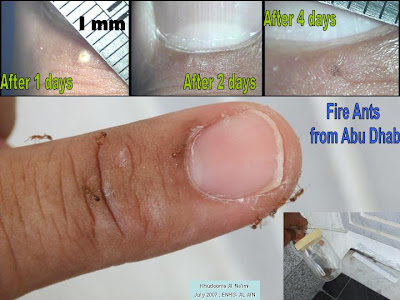
Khudooma from the Emirates Natural History Group had some fun with fire ants:


During finishing my visa paper last month in the British Embassy, I walk to the opposite mosque from the embassy to pray, after I get out and during fastening my shoes, I notice a reddish ants on the floor, they look different, so I wondered if they are new to me, I caught one of them to see if they have any special effect but nothing happen, I follow them to their colony in the mosque out wall, I touched by my finger the door step of their colony and suddenly several ants walked over my finger, The ant tend to grab the skin with their mandibles, and double over their abdomens, and inject their stingers, I clean them out easy from my finger, I noticed some little pain and the skin start to be reddish color in the area which was stung, in addition to little burning and itching, It form later a white sore or pustule. The alkaloid based venom causes necrosis or deadening of the tissues.

I decide to return later with an aspirator for ant collection and a camera to documents them better. These ant are called fire ant (Solenopsis) species (Insecta: Hymenoptera: Formicidae: Myrmicinae). In some sensitive people it can cause negative health effect which will need a medical intervention such as our samsum ant which we have here. The huge change in our environment which include 24h running air-condition in some building , and the green areas with continuous irrigation will support many new species of creatures, its need much care when disturbing these ant colonies or mounds.


Saturday, August 11, 2007

ENHG Trip to Hamassa Oasis in Buraimi

The Emirates Natural History Group planned two trips this weekend. One to an Oasis in Al Ain, and the other to an Oasis in Buraimi. Buraimi is a little town in Oman, bordering with Al Ain. I lived in Buraimi for 5 years, way before they made the border between the two countries 3-4 years ago.
Today's trip was about comparing the oases of Al Ain with the state of oases in Buraimi. Though separated by only a couple of kilometers, the difference is significant as the Hamassa oasis of Buraimi does not have the water resources available to farmers in Al Ain.
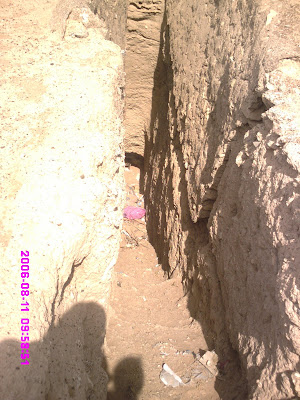
We met up at the Buraimi Hotel at 8 am and convoyed down to Hamassa, and toured some of the mudbrick ruins of Hamassa, before entering the oasis to see the state of the farming there.
I decided to be a photographer like Amer and took a few pictures.
By 9am, it was just too hot for me. I dragged my feet and followed the group around trying real hard to listen to Brian explain all about the ruins, well systems, water...
We were out in 40 degree heat for a couple of hours.


This is a well, about 7-8m deep [Below] Dates for drying [below]
This man was working in the farm and he offered us some dates. He washed them for us in his hands and held them out. I noticed his hands were constantly shaking.


Amer said he really wants to take a picture of a dead human being. I suggested the morgue @ the Tawam Hospital, but he said he'd rather kill me and take a picture. He did find a dead goat and took a picture.

At the second site we visited, there were lots of skeletons of animals- cows, goats, camels. Not sure what this is [below]
Beautiful, tall, majestic date palm trees [below]


Thursday, August 02, 2007

Islam & the Environment

Here's a nice article by Judge C.G. Weeramantry on Islam, the environment and humankind
The Muslim Guardian- Islam, the environment and humankind

Tuesday, July 31, 2007

Extreme weather brings flood chaos round the world

People in countries across the world, from China to India and Sudan to Indonesia, are coping with severe wet weather, highlighting the position of flooding as the most deadly of all natural disasters.
While single events cannot be linked to climate change, the flooding come as research suggests that global warming will increase rainfall in some parts of the world, including the Indian monsoon, and increase the number of hurricanes – both due increased evaporation in a warmer world.
One person in 10 worldwide, including one in eight city-dwellers, lives less than 10 metres above sea-level and near the coast. This is an "at-risk zone" for flooding and stronger storms exacerbated by climate change, a recent study found.

Read more.

Sunday, April 22, 2007

Friday, March 02, 2007

Small Change big Difference

This is one of the best changes ever.. towards creating environmentally aware citizens. I'm so happy, Alhamdulillah and I bought my first bag as well!

In a push to reduce the millions of plastic bags that pollute the UAE's ecosystem every year, MAF Hypermarkets (Carrefour) today introduced reusable bags at their checkout counters as an alternative to plastic bags.Shoppers will be encouraged to purchase their own big reusable bags from Carrefour at the checkout for 2 Dirhams (cost price). If damaged at any point, the bags can be replaced at any Carrefour outlet free of charge.

Friday, December 01, 2006

Please save water

I'm reposting this, as my information was incomplete the first time. I was waiting for my friend Anup to do the research for me :P


“Consider the water which you drink. Was it you that brought it down from the rain cloud or We? If We had pleased, We could make it bitter” [Qur'an 56:68-70].

Please please save water. It's an easy thing to do. Save water when you turn on taps, when you use the dishwasher, when you wash your clothes and dishes, and when you water your garden.
Please do not exploit this miraculous blessing from Allah (swt). Please follow the sunnah. Save each drop, and thank Allah for this bountiful blessing.

The Prophet Muhammad (pbuh):
- Performed ablution using one mudd [i.e. a measure equal to a handful of water] (Al-Tirmidhi)
- Took a shower using one sa` [four handfuls].
- said "Do not waste water even if performing ablution on the bank of a fast-flowing (large) river.

Why should we conserve water?
Think of what happens @ the end of the pipe. Where does tap water come from?
From surface water, including reservoirs, lakes and rivers, and the rest from ground waters. The latter come from aquifers, which are underground geological formations that store rainwater. The rainwater seeps through porous strata such as sandstone and chalk. Water companies drill wells or bore holes into aquifers and draw water from them.
Major cities are usually supplied from the larger volume surface waters, whereas ground waters supply smaller populations, although this is not always the case. There are also areas that receive water from a mixture of sources.
Water is treated at water treatment works before flowing through water mains, sometimes over considerable distances, to arrive at your home. Samples are taken at each stage of treatment and distribution along the way, and tested by the water company to make sure that you receive high quality water.
Image taken from DWI- Dams cause loss and destruction of habitat
- Removal of surface water causes erosion
- Increase in saltwater intrusion can cause change

The major problem with water today is it's commercialisation. And what this is doing is making water expensive for poor people, even in rich countries.
From the United Nations Human Development Report:
- Access to piped water into the household averages about 85% for the wealthiest 20% of the population, compared with 25% for the poorest 20%
- “Already, corporations own or operate water systems across the globe that bring in about $200 billion a year. Yet they serve only about 7 percent of the world’s population, leaving a potentially vast market untapped.” (John Tagliabue, As Multinationals Run the Taps, Anger Rises Over Water for Profit, New York Times, August 26, 2002)
An amazing resource is: Water Conserve

Here are some water saving tips from American Water and Energy Savers:
  1. Create an awareness of the need for water conservation among your children. Avoid the purchase of recreational water toys which require a constant stream of water.
  2. Be aware of and follow all water conservation and water shortage rules and restrictions which may be in effect in your area.
  3. Encourage your employer to promote water conservation at the workplace. Suggest that water conservation be put in the employee orientation manual and training program.
  4. Patronize businesses which practice and promote water conservation.
  5. Report all significant water losses (broken pipes, open hydrants, errant sprinklers, abandoned free-flowing wells, etc.) to the property owner, local authorities or your Water Management District.
  6. Encourage your school system and local government to help develop and promote a water conservation ethic among children and adults.
  7. Support projects that will lead to an increased use of reclaimed waste water for irrigation and other uses.
  8. Support efforts and programs to create a concern for water conservation among tourists and visitors to our state. Make sure your visitors understand the need for, and benefits of, water conservation.
  9. Encourage your friends and neighbors to be part of a water conscious community. Promote water conservation in community newsletters, on bulletin boards and by example.
  10. Conserve water because it is the right thing to do. Don't waste water just because someone else is footing the bill such as when you are staying at a hotel.
  11. Try to do one thing each day that will result in a savings of water. Don't worry if the savings is minimal. Every drop counts. And every person can make a difference. So tell your friends, neighbors and co-workers to "Turn it Off" and "Keep it Off".